

Voices as Visuals: A Review of Community Radio as a Graphic Communication Tool for Intercultural Social Change
Abstract
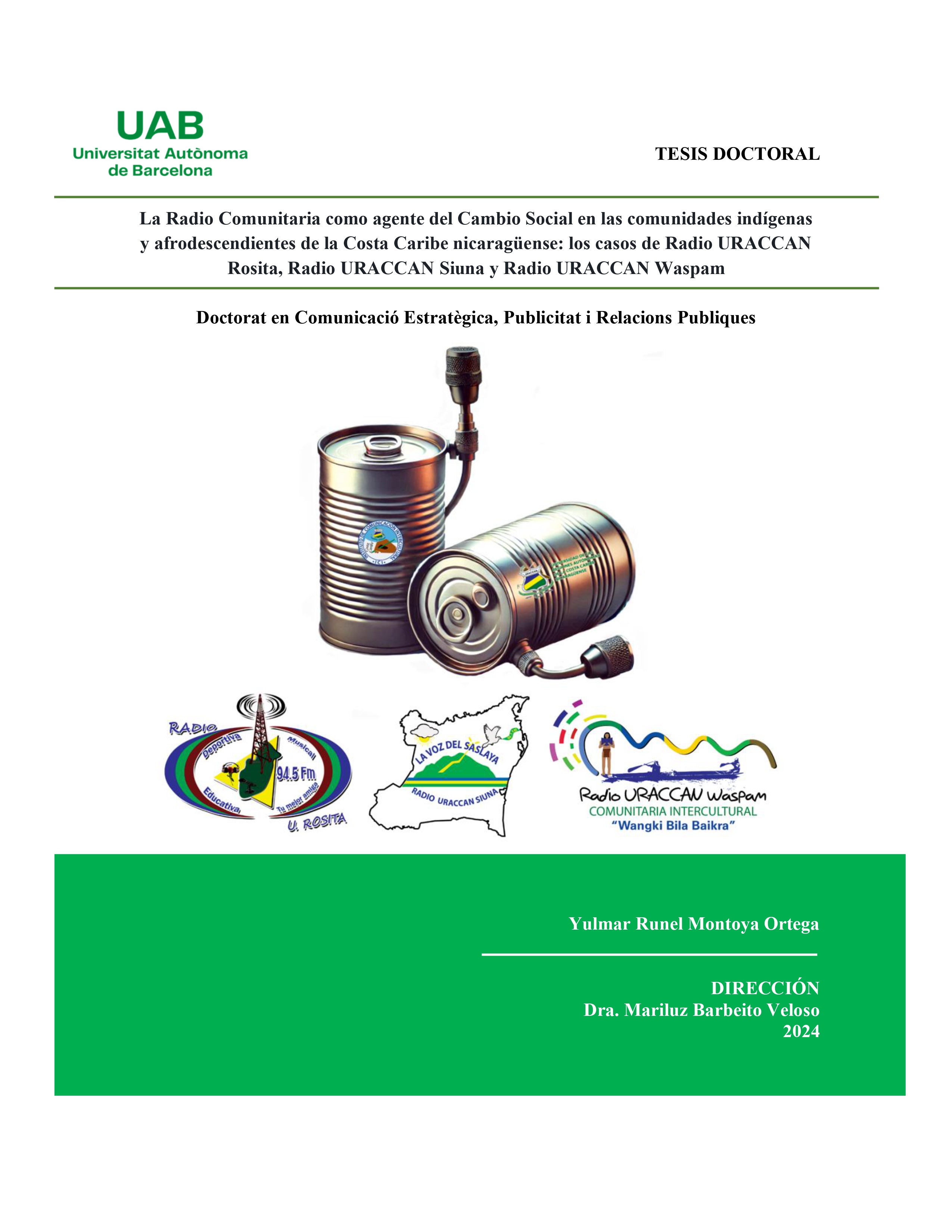
This review examines Montoya Ortega’s dissertation on the transformative role of community radio among Indigenous and Afro-descendant communities in Nicaragua. Based on three URACCAN radio stations, it shows how campaigns on health, land rights, and identity enhance strategic and participatory communication. Using a mixed-methods approach, it traces the relationship between civic action, culture, and identity. The study offers graphic communicators and public service communicators valuable tools for designing social change, revealing how sound, rhythm, and collective memory can generate new forms of visual narrative.
Keywords
community radio, graphic communication, intercultural media, social change, visual storytellingReferences
Barlow, David M., and Johnson, Steve. (2008). Finding a voice Community radio: role, sustainability and practice. Radio Journal: International Studies in Broadcast & Audio Media, 6(2-3), 75-85.
Bosch, Tanja (2014). Community radio in post-apartheid South Africa: The case of Bush Radio. Television & New Media, 15(2), 105–120. https://doi.org/10.1177/1527476412463519
Brown, Tim (2009). Change by design: How design thinking creates new alternatives for business and society. Harvard Business Press.
Escobar, Arturo (2018). Designs for the pluriverse: Radical interdependence, autonomy, and the making of worlds. Duke University Press.
García-García, Javier (2013). Transformations in the Third Sector: The Case of Community Radio in Spain. adComunica. Scientific Journal of Strategies, Trends and Innovation in Communication, (5), 111-131.
Krippendorff, Klaus (2006). The semantic turn: A new foundation for design. CRC Press.
Montoya Ortega, Yulmar Runel (2025). La Radio Comunitaria como agente del Cambio Social en las comunidades indígenas y afrodescendientes de la Costa Caribe nicaragüense: los casos de Radio URACCAN Rosita, Radio URACCAN Siuna y Radio URACCAN Waspam.
Overview – Design Challenge. (2025). Washington.edu. https://depts.washington.edu/designme/human-centered-design-2/human-centered-design/
Rimmer, Annette (2020). Breaking the silence: community radio, women, and empowerment. Community Development Journal, 56(2). https://doi.org/10.1093/cdj/bsz030
URACCAN. (2021). Plan Intercultural de Vida Institucional. Universidad de las Regiones Autónomas de la Costa Caribe Nicaragüense.
Verma, Amit, Singh, Preeti and Arora, Neha (2025). Empowering the Voiceless: A systematic review of literature on community radio’s impact on marginalized communities in India. Journal of Communication and Management, 4(01), 45–55. https://doi.org/10.58966/jcm2025417
Published
How to Cite
Downloads
Copyright (c) 2026 Henry Kojo Bonsu-Owu

This work is licensed under a Creative Commons Attribution 4.0 International License.